1. Start with income you can support
Use the rent roll and leases to establish scheduled rent. Compare the scheduled rents with actual collections. Then account for vacancy and collection losses instead of assuming every dollar will arrive. Add other income, such as parking or laundry, only when the amount has supporting records.
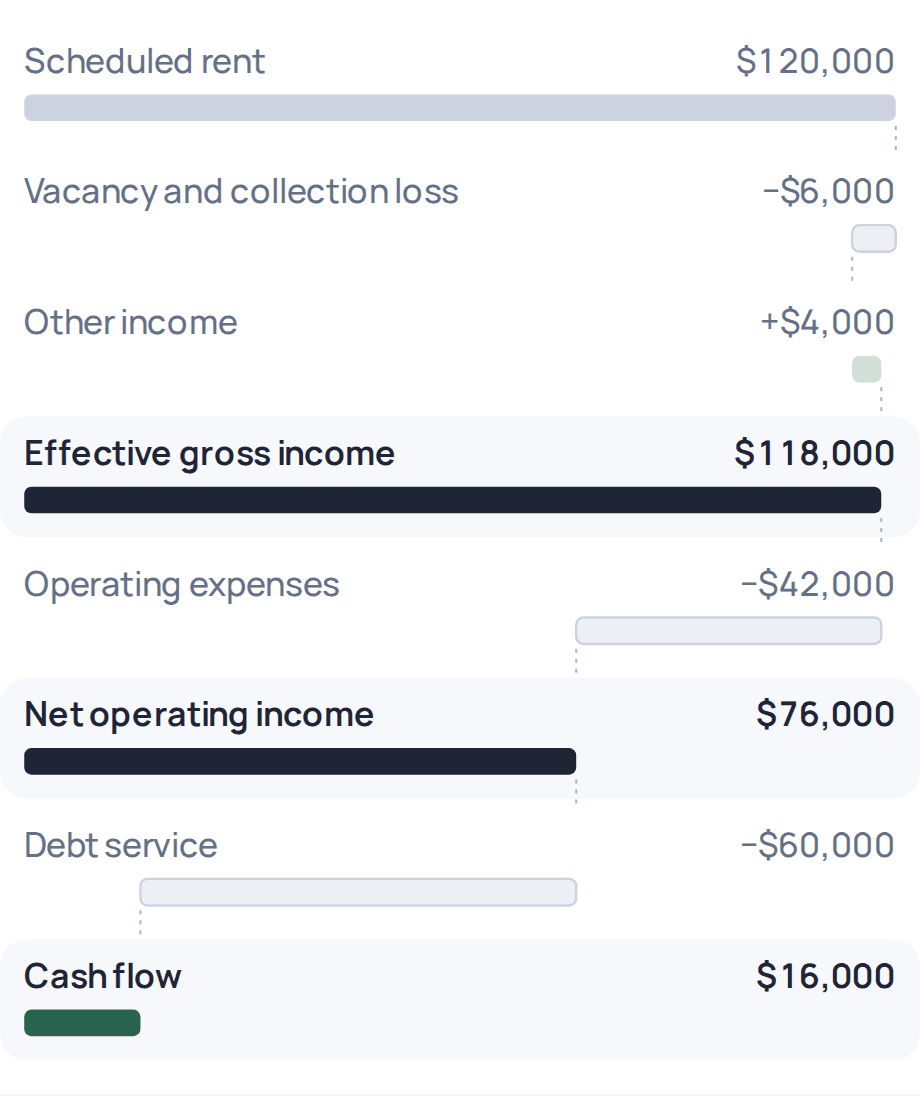
Effective gross income in an illustrative year: $120,000 in scheduled rent, less $6,000 for vacancy and collection losses, plus $4,000 in other income gives $118,000. The vacancy allowance is an assumption in the worked example, not a market benchmark.
2. Which expenses belong in net operating income?
The recurring costs of running the property belong in net operating income: property taxes, insurance, utilities paid by the owner, maintenance, management and other regular items. Loan payments and income tax do not. Reconcile each category with actual invoices and with the scope of the budget, because a cost a listing leaves out is not a cost the building avoids.
With $42,000 in annual operating expenses, the worked example produces $76,000 in net operating income: $118,000 − $42,000. A listing that reports only taxes and heating does not provide a complete operating budget.
Major capital improvements need a separate cash budget. The accounting and tax treatment of capital work differs from everyday repairs; ask your accountant how the work should be classified.
3. Subtract the full debt service
Use the mortgage payments, including both principal and interest, for the same period as the income and expenses. Principal repayment is a cash outflow even though principal repayment is not an operating expense.
With $60,000 in annual debt payments, close to what a $900,000 mortgage costs at 4.5% over a 25-year amortization, the worked example leaves $16,000 a year, or about $1,333 a month. The $16,000 is projected operating cash flow after debt service, before income tax, capital projects and other cash movements. The worked result does not promise that the full amount can be withdrawn.
A positive annual result can still hide a difficult month. Insurance renewals, property tax bills, repairs and vacant units can create uneven cash needs. Keep a separate view of liquidity and reserves.
4. Read each ratio for the question it answers
The capitalization rate compares NOI with the purchase price: $76,000 ÷ $1,200,000 is about 6.33%. The capitalization rate describes the property before the effect of financing and is not the return on your down payment.
Cash-on-cash return compares the cash flow with the initial cash invested. If the down payment, closing costs and initial work total $350,000, the example’s $16,000 is about 4.57% before tax. Omitting closing costs would overstate the cash-on-cash return.
Debt service coverage compares NOI with debt service: $76,000 ÷ $60,000 is about 1.27. Lenders can use different expense assumptions and underwriting definitions, so the 1.27 ratio alone does not establish loan eligibility.
5. Test what could change the result
Recalculate cash flow with lower collected rent, higher operating costs and a different interest rate at renewal. Keep each assumption visible and compare the cautious case with the base case.
Mortgage renewal deserves a separate pass. After a five-year term the example’s mortgage is down to about $790,000, and renewing at 6% over the remaining 20 years of amortization takes annual payments to roughly $68,000. With net operating income unchanged, cash flow falls from $16,000 to about $8,000 and debt service coverage from 1.27 to 1.12. If a lender expects 1.20, the renewal changes the file and not only the monthly amount.
In Dewin, store the base case and the cautious case as separate scenarios, review the sources and missing inputs, then compare the acquisition plan with recorded operations after purchase. The financial engine calculates the results; the quality of the input evidence remains your responsibility.
What is a good cash flow per unit?
No per-unit amount holds from one market to the next, and a figure quoted without the building’s expenses says very little. The arithmetic can be checked: an eight-unit building with $16,000 of annual cash flow produces about $167 per unit per month. The $167 must absorb a furnace, a turnover or a month of unpaid rent. Compare the monthly amount with the building’s replacements: a $60,000 roof ten years out represents about $500 a month of the same cash flow, and the worked example does not set that money aside.
Is cash flow the same as taxable income?
Cash flow and taxable rental income are not the same figure, and the gap is wide enough to plan around. Of the $60,000 in payments, roughly $40,000 is interest in the first year and $20,000 is principal: interest is generally deductible, principal is not, so the $16,000 of cash comes with a larger figure on the tax side. Capital cost allowance moves the result the other way and has consequences on resale. Dewin calculates cash, not your tax position; take the split to your accountant with the lender’s statement rather than an estimate.
Calculation method
The worked example follows Dewin’s financial engine: effective income, operating expenses, debt service and initial cash are kept separate. All amounts are illustrative, in Canadian dollars, before income tax.
Sources
- Canada Revenue Agency, Rental Income (T4036): deductible interest, capital cost allowance and recapture on sale
- Bank of Canada, interest rates and posted mortgage rates
- CMHC, Rental Market Report: measured vacancy rates and average rents by centre
- Statistics Canada, table 18-10-0004-01: Consumer Price Index by component, including property taxes and insurance
Drafted with AI assistance, reviewed before publication by Mathis Desgagné.
These explanations describe calculations and a research process. They do not replace advice specific to your property or financing.