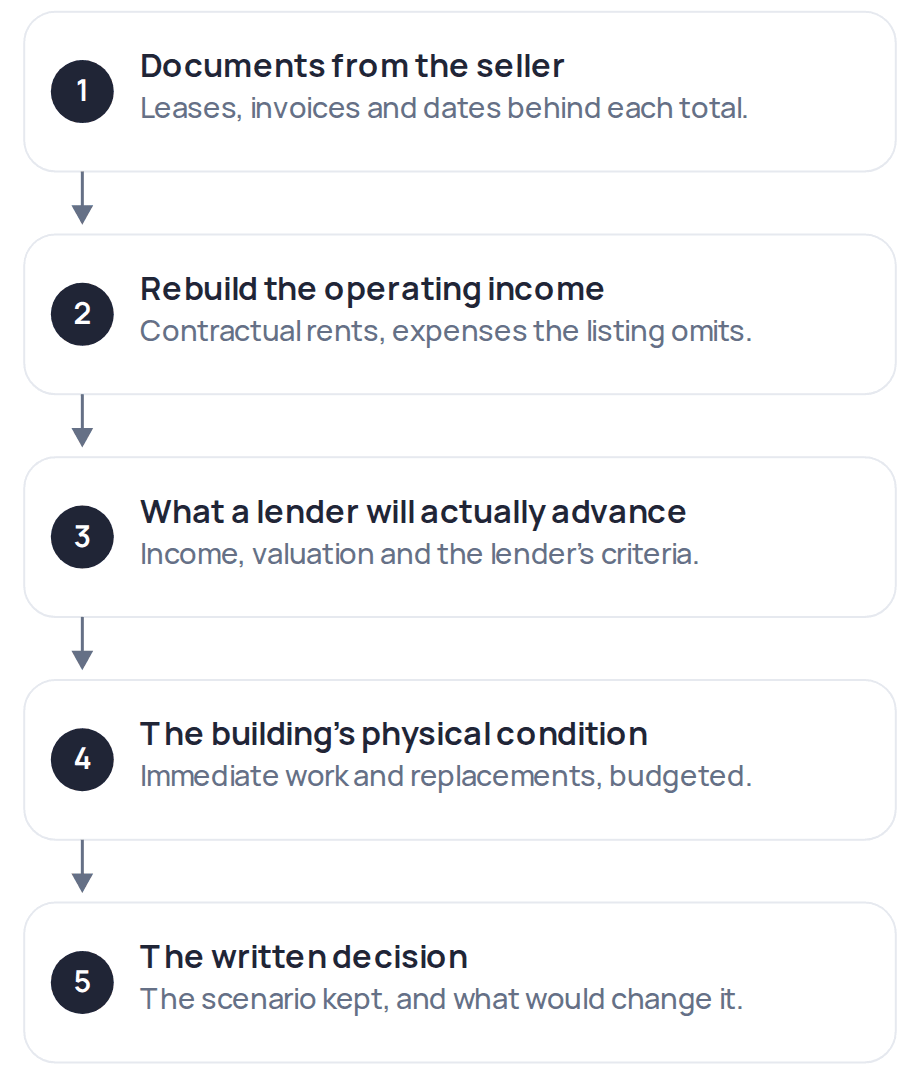
What documents should you ask the seller for?
Ask the seller for the documents behind each total rather than the totals themselves: the leases behind the rent roll, the invoices behind an expense line, the dates behind both. A spreadsheet total is easier to evaluate when the supporting leases, invoices and dates are available. The listing and the seller’s summary are starting points, not verification documents.
Record the source and period for each figure. Mixing a monthly rent total with annual expenses, or last year’s costs with a future rent estimate, can create a convincing result with no consistent basis.
- Rent roll, unit types, leases, occupancy and rent collection records.
- Property tax bills, insurance and owner-paid utilities.
- Maintenance history, service contracts and known work.
- Financing assumptions, acquisition costs and available cash.
Rebuild the operating income
Separate contractual rents from potential market rents. A vacant unit does not earn its advertised rent today. A below-market occupied unit does not necessarily move to market rent next year; confirm the applicable rules and timing for the property’s province.
Include the expenses that the listing leaves out. Property management has an economic cost even if you intend to do the work yourself. Budget recurring maintenance separately from major projects and identify amounts that remain estimates.
What are the warning signs in a rent roll?
The warning signs worth acting on are rent roll figures that no document reproduces. Look for identical rents in units of different sizes, a rent that matches the neighbourhood average to the dollar, a lease signed three weeks before the listing, a unit carried at the post-renovation rent, or collections that trail the roll by a month all the way down the page. No single warning sign proves a problem; every warning sign is a question to answer before the figure enters your analysis. When the answer is only a verbal assurance, keep the figure as an assumption and test the purchase without the unverified amount.
How much will a lender actually advance?
A lender does not advance a fixed share of the asking price: the amount follows from the property’s income, the lender’s valuation, the lender’s criteria and the borrower’s circumstances. Any one of those four constraints can limit the loan. Compare the effect on cash required, payments and debt coverage.
For a CMHC-insured scenario, use the Dewin calculator as a preliminary comparison and consult the current program documentation and an approved lender. Do not treat a software estimate as an approval. Keep interest rate, amortization, insurance premium and acquisition costs visible in the analysis.
Give the building’s condition a cash budget
List immediate work and potential major replacements with an estimated timing and supporting evidence. An inspection and specialist estimates help assess what a listing cannot establish.
Include acquisition costs and an appropriate liquidity reserve alongside the down payment. A transaction can show positive operating cash flow while requiring more cash at closing or during the first year than planned. In the cash flow guide, the $350,000 of cash invested is a $300,000 down payment plus roughly $50,000 of land transfer tax, notary or lawyer fees, inspection, appraisal and first-year work, not a down payment on its own.
What do you do with a number you cannot confirm?
Keep an unconfirmed figure as an assumption, write down the evidence that would settle the amount, and run the purchase at the unfavourable end of the range. An unknown heating cost in a building where the owner pays heat is not a small gap: the heating cost can separate a workable year from a shortfall. If the purchase only holds at the favourable end, the unconfirmed figure is carrying the purchase and belongs before the offer rather than after. Some questions can be carried into a conditional offer; other questions have to be answered before signing.
Write down the decision and what would change it
Compare a base scenario with a cautious case. Test the consequences of a vacant unit, a repair, higher expenses or a changed financing offer. Check which assumptions make the purchase acceptable and which would make you renegotiate or step away.
Save the selected scenario, outstanding questions and conditions to confirm. After purchase, compare the plan with actual rents, expenses and financing. The comparison turns the analysis into something you can learn from instead of a document forgotten after closing.
Dewin supports the sequence: review sourced inputs, compare scenarios, share a report and carry the chosen plan into your portfolio. Professional inspections, legal review, tax advice and lender approval remain separate parts of the acquisition.
Sources
- CMHC, MLI Select: current program documentation for multi-unit mortgage loan insurance
- Canada Revenue Agency, capital cost allowance for rental property: which work is depreciated rather than deducted
- CMHC, rental market data tables: vacancy rates and average rents by centre and unit type
- Government of Ontario, residential rent increases: the annual guideline and the exceptions to it
Drafted with AI assistance, reviewed before publication by Mathis Desgagné.
These explanations describe calculations and a research process. They do not replace advice specific to your property or financing.